Sliding Doors Are Quietly Becoming the Most Frustrating Feature in Modern Homes
Sliding doors do not usually get much attention until they become annoying.
They sit at the back of the house, opening onto the garden, looking fairly harmless. Then one day they start dragging. The handle feels stiffer than it should. The lock needs a second attempt. Somebody gives the door a harder shove and says, “It’s always been a bit awkward.”
That sentence is usually where the trouble starts.
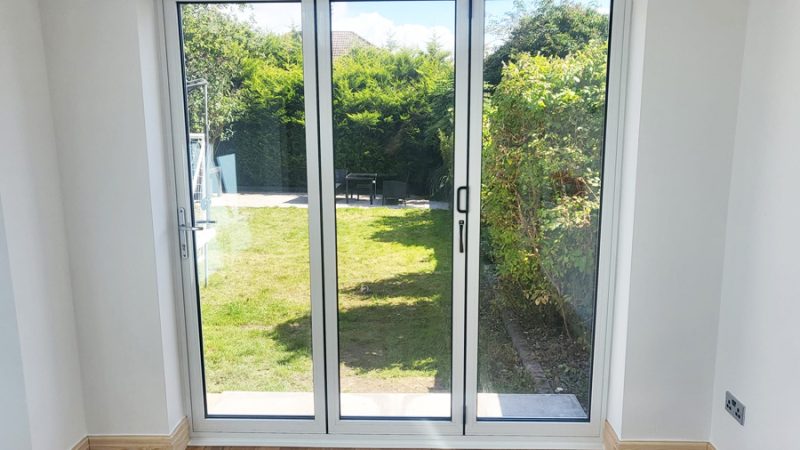
Across plenty of homes, especially those with older patio systems or newer large glazed extensions, sliding patio door repairs are becoming a much more common conversation. Not because sliding doors are suddenly worse than they used to be. More because homeowners have spent years expecting them to behave like fixed windows rather than moving mechanical systems.
They are not fixed windows.
They are heavy doors sitting on rollers, running through tracks, relying on locking points, seals, drainage channels and alignment that needs to remain fairly precise.
And when any of that starts drifting, the whole thing becomes irritating very quickly.
The showroom version never had muddy trainers
Sliding doors look effortless in showrooms.
Clean floor. Perfectly level track. No rain. No grit. No dog hair. No children running in from the garden. Nobody dragging a plant pot across the threshold. Nobody spilling compost near the track in April then forgetting about it until November.
Real houses are different.
In real houses, sliding doors collect muck constantly. Small bits of stone from patios. Dust. leaves. Moss. Sand from planters. Pet hair. The sort of mess that looks harmless until it compacts down into the running channel and starts wearing away at the rollers underneath.
You can clean the glass every week and still have a door system slowly destroying itself at floor level.
That is the bit most people miss.
The door still looks fine. The frame still looks fine. The glass still looks fine. So the assumption is that the system is fine.
Then the movement gets heavier.
Only slightly at first.
Then noticeably.
Then someone starts using two hands.
“It still opens” is not the same as working properly
This is one of the most expensive misunderstandings in home maintenance.
A sliding door that still opens is not necessarily functioning correctly. It may simply be tolerating abuse.
You see it all the time. Doors that need lifting slightly before they move. Doors that scrape through one section of the track. Doors that lock only if pulled towards the frame at exactly the right angle. Doors that make a grinding noise nobody in the house really hears any more because they have got used to it.
That is not normal.
It is just familiar.
The problem with gradual deterioration is that homeowners adapt to it. Nobody wakes up one morning and suddenly accepts a terrible sliding door. It becomes terrible slowly enough that the household adjusts around it.
The heavy push becomes normal.
The awkward lock becomes normal.
The little kick at the bottom becomes normal.
Then a visitor tries to use the door and says, “Is this meant to be this stiff?”
Usually not.
Modern homes made doors bigger, but not always better
There has been a huge shift in how people use the back of their homes.
Big kitchen-diners. Garden rooms. Open-plan extensions. Wide glazed openings designed to make the house feel brighter and larger.
Sliding doors fitted perfectly into that trend.
They were neat, modern and space-saving. They gave people big panes of glass without the folding complexity of bifolds. In many homes, they still make excellent sense.
But larger doors also bring larger loads.
A small old patio slider is one thing. Huge modern sliding panels are another. The glass is heavy. The rollers work hard. The track needs to stay clean and level. The installation needs to be properly supported.
If that system was fitted cheaply, rushed during a busy renovation, or installed on an extension that later settles slightly, problems can appear much earlier than expected.
Not always dramatic problems.
Just daily irritating ones.
The door feels heavier in damp weather.
The lock catches.
The panel starts sitting slightly low on one side.
That is often how it begins.
The track tells you nearly everything
Ask someone experienced to inspect a sliding patio door and they will usually look low down before anything else.
The track gives the game away.
Clean, straight, unobstructed tracks usually tell one story. Rough, dirty, pitted, dented or contaminated tracks tell another. You can often see the history of the door in that small channel.
Years of dragging.
Years of grit.
Years of forcing.
Years of nobody quite knowing they were supposed to clean it properly.
One thing I see often is homeowners spraying lubricant into a dirty track. It feels logical. The door is stiff, so they try to make it slippery.
But lubricant mixed with grit is not much of a solution. It can turn into a grinding paste. The rollers keep running through it and the movement often gets worse over time.
A dry, clean, correctly adjusted track is far better than a dirty one filled with whatever spray happened to be in the garage.
Bluntly, some doors are being damaged by kindness.
The lock often gets blamed unfairly
A sticking sliding door lock does not always mean the lock has failed.
Quite often, the door has dropped slightly. Or the panel is no longer meeting the frame squarely. Or the rollers have worn unevenly, so the locking points are no longer lining up with the keeps.
The handle then feels stiff because the mechanism is fighting against poor alignment.
Homeowners replace handles. They buy new locks online. They adjust keeps randomly. Sometimes they make the problem worse without meaning to.
The lock was not the original issue.
It was the symptom.
This happens with UPVC doors too. A mechanism can feel faulty when really the door has moved out of line. That is why proper UPVC mechanism repairs involve looking at the whole door, not just the part that feels stiff in your hand.
Doors are simple until they are not.
Then every part starts blaming another part.
Wet weather makes bad doors honest
A lot of sliding doors reveal their true condition after long wet spells.
Damp gets into tracks. Dirt clumps together. Drainage channels struggle. Cold nights tighten tolerances. Frames move slightly. Rollers already close to failure begin sounding rougher.
The door that was “fine in summer” suddenly becomes a nuisance in autumn.
That is not bad luck. It is usually accumulated wear being exposed by the weather.
West Yorkshire homes get plenty of this. Not just heavy rain, but long damp periods where nothing properly dries out. Patio thresholds take a beating. Garden debris sits wet. Older tracks corrode. Seals lose their shape.
You do not need a dramatic storm for door problems to appear.
A month of miserable, wet weather will do it.
The annoying part is that many of these issues start small enough to fix sensibly. Left alone, they spread into other parts of the system.
Replacement is not always the clever answer
There is a tendency with older patio doors to assume replacement must be the next step.
Sometimes it is.
A badly warped frame, severely damaged track, failed glazing, rotten surrounding structure or a door system that has been butchered repeatedly may not be worth saving.
But many stiff sliding doors are not finished. They are neglected.
That is a different thing.
Worn rollers can often be replaced. Tracks can sometimes be repaired or improved. Locks can be realigned. Mechanisms can be serviced. Doors can be adjusted so they run far better than they have for years.
This matters more now because homeowners are watching renovation costs carefully. Full replacement is expensive, and not everyone wants to rip out a door system when the basic structure still has life left in it.
Repair-first thinking is becoming more common.
Not glamorous. Sensible.
There is a lot of that about at the moment.
The DIY era has made some repairs messier
People are more willing to try fixing things themselves now. That is not always bad. Basic maintenance should not be mysterious.
Cleaning tracks properly, checking visible debris, avoiding unnecessary force – all good.
The trouble starts when people begin adjusting structural or locking components without understanding the system. Sliding doors are not all built the same way. Roller access differs. Adjustment points differ. Locking systems differ. Older UPVC patio doors can have discontinued hardware that does not respond well to enthusiastic tinkering.
A few common mistakes keep appearing:
- Forcing the handle until internal locking parts bend or snap
- Spraying oil or grease into dirty running tracks
- Adjusting keeps randomly without checking roller height
- Trying to lift dropped panels without supporting the weight properly
- Ignoring blocked drainage channels until corrosion sets in
None of these usually come from carelessness. They come from frustration.
The door is annoying. The repair looks like it should be simple. A five-minute video makes it look manageable.
Then the door ends up worse.
That happens more than people admit.
Sliding doors suffer from being too ordinary
Bifold doors get the drama.
They look expensive. They fold neatly. They attract comments. When they fail, it feels like a big event because they were sold as a feature.
Sliding doors are quieter.
They are practical. Familiar. Often taken for granted.
That is partly why they get neglected for longer. A stiff bifold might worry a homeowner quickly because the system looks complex. A stiff sliding door just gets shoved harder for another year.
This is why sliding door problems can become surprisingly advanced before anyone calls for help.
By the time someone admits the patio door is “a bit heavy”, it may have been damaging its rollers and track for ages.
A door should not need a wrestling match.
That sounds obvious written down.
In houses, people live with it for years.
Newer sliding systems are not immune
It is easy to assume this is only an old UPVC patio door problem.
Not true.
Modern large sliders can develop faults too, especially if installation quality was poor or the system is carrying heavy glass on underwhelming running gear.
Some newer doors are beautifully engineered. Others are not.
The difference is not always obvious from the outside. Two large sliding doors can look similar in photographs but perform completely differently after five years of daily use.
Hardware quality matters.
Installation matters.
Support underneath the track matters.
Drainage matters.
The building around the door matters.
That last one gets overlooked. A modern extension can move slightly after completion. If the opening shifts by even a small amount, a sliding system may begin rubbing, catching or locking awkwardly.
The door then gets blamed for a problem caused partly by the structure around it.
Houses are not as still as people think.
Security should not be an afterthought
A sliding door that does not close or lock cleanly is not only inconvenient.
It may be less secure than the homeowner assumes.
If the locking points are not engaging correctly, or if the door has dropped enough to affect alignment, the handle might still move while the system itself is not locking as strongly as it should.
That is especially concerning on rear doors, which are often hidden from the road.
People tend to focus on stiffness because that is what they feel daily. Security gets considered only when the lock fails completely.
That is the wrong way round really.
A patio door that needs lifting, pushing or pulling into place before it locks is already telling you something. It is not seated properly. It needs attention before the mechanism takes more damage.
The same applies to older UPVC back doors. If locking becomes a performance, the door is not behaving properly.
Same-day demand usually follows months of warning signs
Emergency door repairs rarely come from nowhere.
Most have a long backstory.
The door was stiff in spring. The lock caught in summer. The track sounded rough by autumn. Then one cold wet evening it refused to close.
That is when same-day repair becomes urgent.
This pattern is particularly common with patio and sliding doors because homeowners keep using them long after the first signs appear. Unlike a broken appliance, a stiff door still sort of functions, so it stays on the mental “later” list.
Later becomes winter.
Winter becomes a jammed lock.
Then suddenly the whole household revolves around getting the back door secure before night.
That is why same-day door repairs are often less about sudden failures and more about delayed maintenance finally reaching the point where it cannot be ignored.
Not always. But often.
The quiet cost is energy loss
A badly aligned sliding door can also affect warmth.
Not always dramatically enough for people to notice at first. Just small draughts. Cold spots near the frame. More condensation around the glazing. A room that never feels quite as comfortable as it should.
People blame the weather.
Sometimes the door is not sealing properly.
Once rollers drop or locking points fail to pull the panel in tightly, the compression against the seals can weaken. That allows cold air to creep in around areas that should be closing cleanly.
Energy efficiency is not only about glass ratings and insulation thickness. The door has to shut properly.
That sounds dull.
It matters.
Especially in homes with large open-plan kitchens where the patio door may cover a big section of external wall. A poor seal there can make the whole space feel colder.
The best repairs are often boring
There is no great theatre in a good sliding door repair.
No dramatic transformation video. No huge reveal. Just a door that moves properly again.
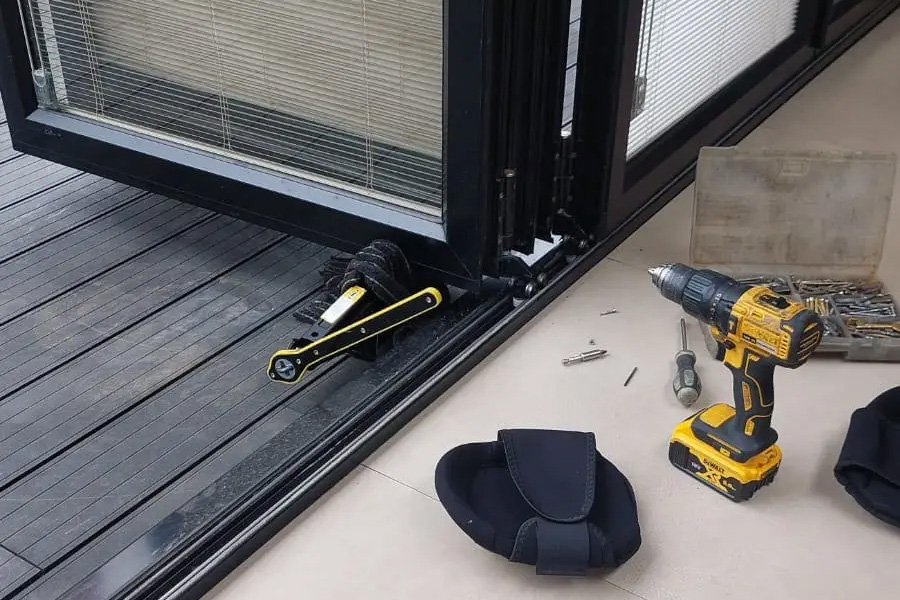
Rollers changed. Track cleaned. Mechanism adjusted. Lock aligned. Drainage checked. Door tested properly.
The homeowner slides it once and says, “I’d forgotten it was meant to feel like that.”
That is usually the best sign.
A properly working sliding door should be almost forgettable. It opens, closes and locks without becoming part of the day’s emotional landscape.
That is the standard.
Not two hands and a shoulder.
Not lifting the panel.
Not avoiding the door because it is raining and you know it will stick.
Just normal use.
People notice when it is already too late
This is the awkward bit.
Most homeowners will not act while the issue is minor because the minor stage does not feel urgent. It feels mildly annoying.
And houses are full of mildly annoying things.
A dripping tap. A sticking drawer. A loose handle. A patio door that needs an extra shove.
The problem is some annoying things stay annoying, while others become expensive.
Sliding doors fall into the second group more often than people realise.
Once the rollers are damaged, they damage the track. Once the alignment drifts, it strains the lock. Once the lock is strained, the handle and mechanism suffer. Once the drainage blocks, hidden corrosion can begin.
Everything is connected underneath.
That is why leaving a stiff sliding door for another year rarely saves money.
It just delays the moment the bill becomes unavoidable.
Maybe ordinary doors deserve more respect
Sliding doors became background features in many homes. Useful, familiar, not especially exciting.
But they do a lot.
They hold heavy glass. Keep weather out. Provide security. Connect living spaces to gardens. Open and close thousands of times over their lifespan. Deal with mud, rain, heat, cold and constant use.
It is not surprising they eventually need attention.
What is surprising is how long homeowners expect them to carry on without any.
The modern home has become full of moving systems people barely think about until they fail. Garage doors. roof windows. bifolds. patio sliders. UPVC locks. Everything looks simple from the outside.
Then the mechanism wears.
Sliding doors are not glamorous. They are not new anymore. They do not get the lifestyle treatment bifolds still get.
But in a lot of houses, they are quietly becoming the most irritating feature of the lot.
Usually one stiff push at a time.